Journal of University of Chinese Academy of Sciences ›› 2026, Vol. 43 ›› Issue (3): 404-413.DOI: 10.7523/j.ucas.2024.046
• Electronics and Computer Science • Previous Articles Next Articles
Jiatong LI, Dong LI( ), Yunhua ZHANG, Xun WANG, He LU
Received:2024-02-08
Accepted:2024-05-09
Online:2026-05-15
Contact:
Dong LI
CLC Number:
Jiatong LI, Dong LI, Yunhua ZHANG, Xun WANG, He LU. Reinforcement of the complete model-based decomposition for polarimetric SAR based on canonical Huynen dichotomy[J]. Journal of University of Chinese Academy of Sciences, 2026, 43(3): 404-413.
Add to citation manager EndNote|Ris|BibTeX
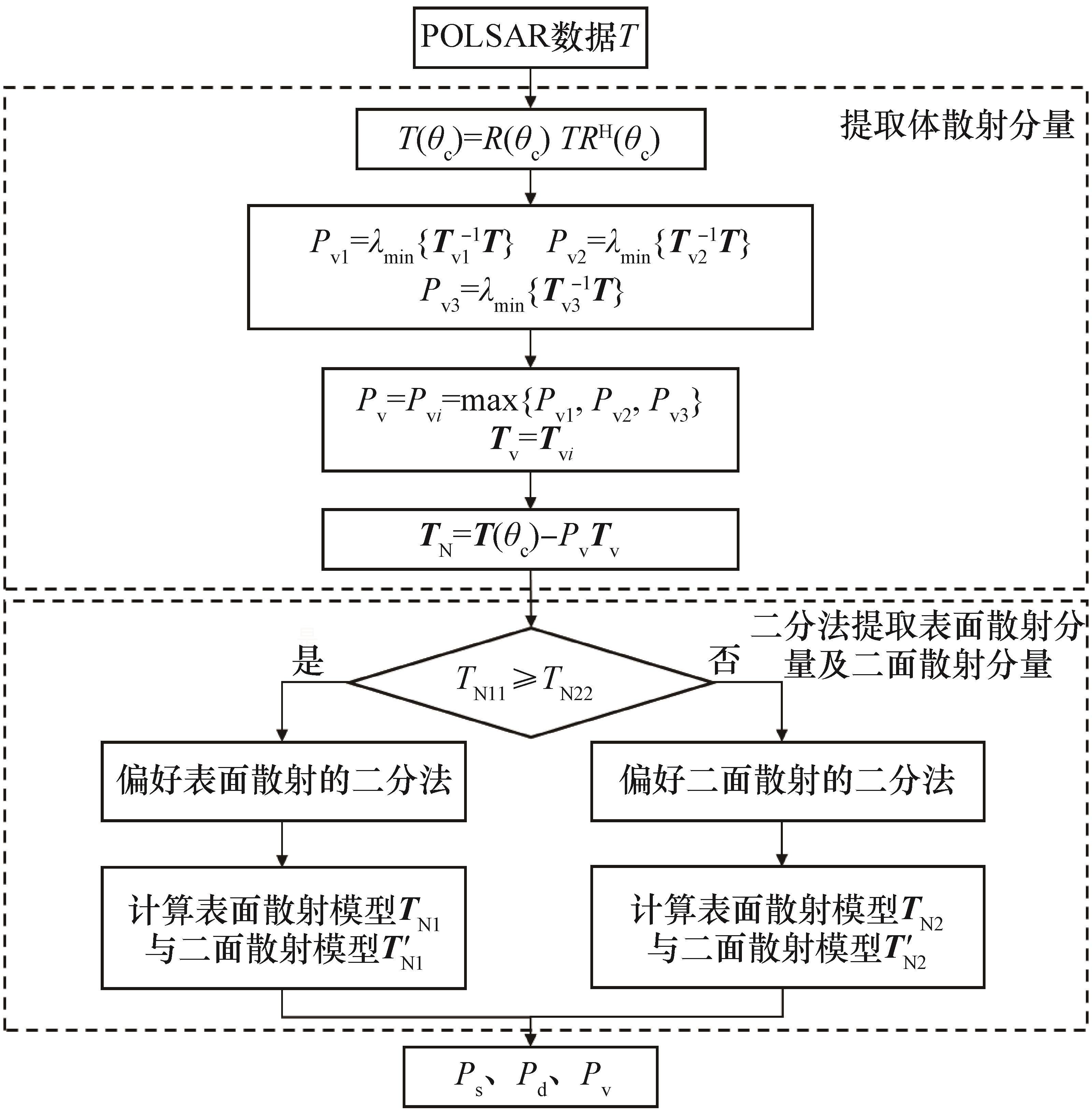
Fig.1 Flow chart of RCMD
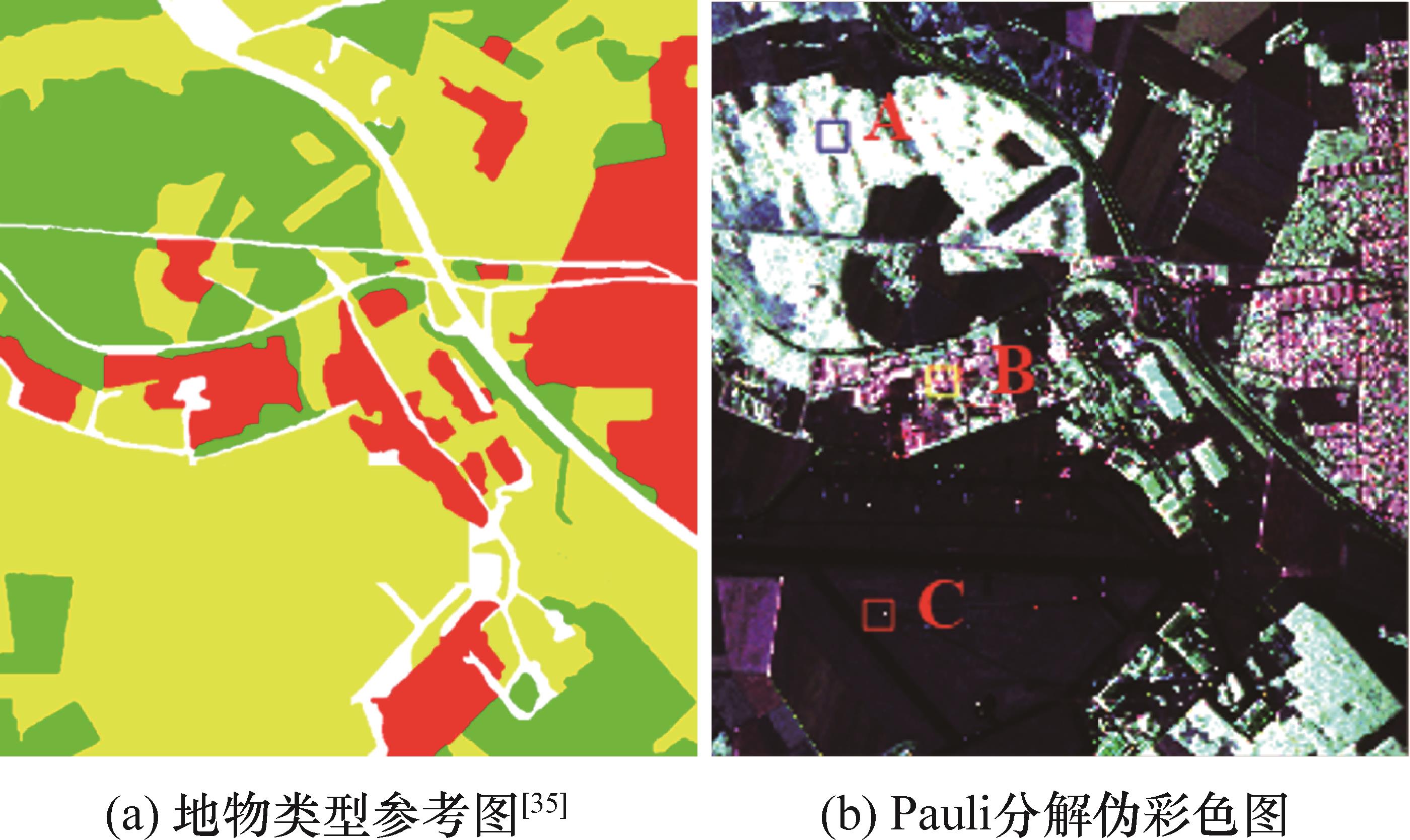
Fig.2 Terrain feature and Pauli RGB pseudo-color image of the airborne full-polarimetric data over Oberpfaffenhofen acquired by ESAR
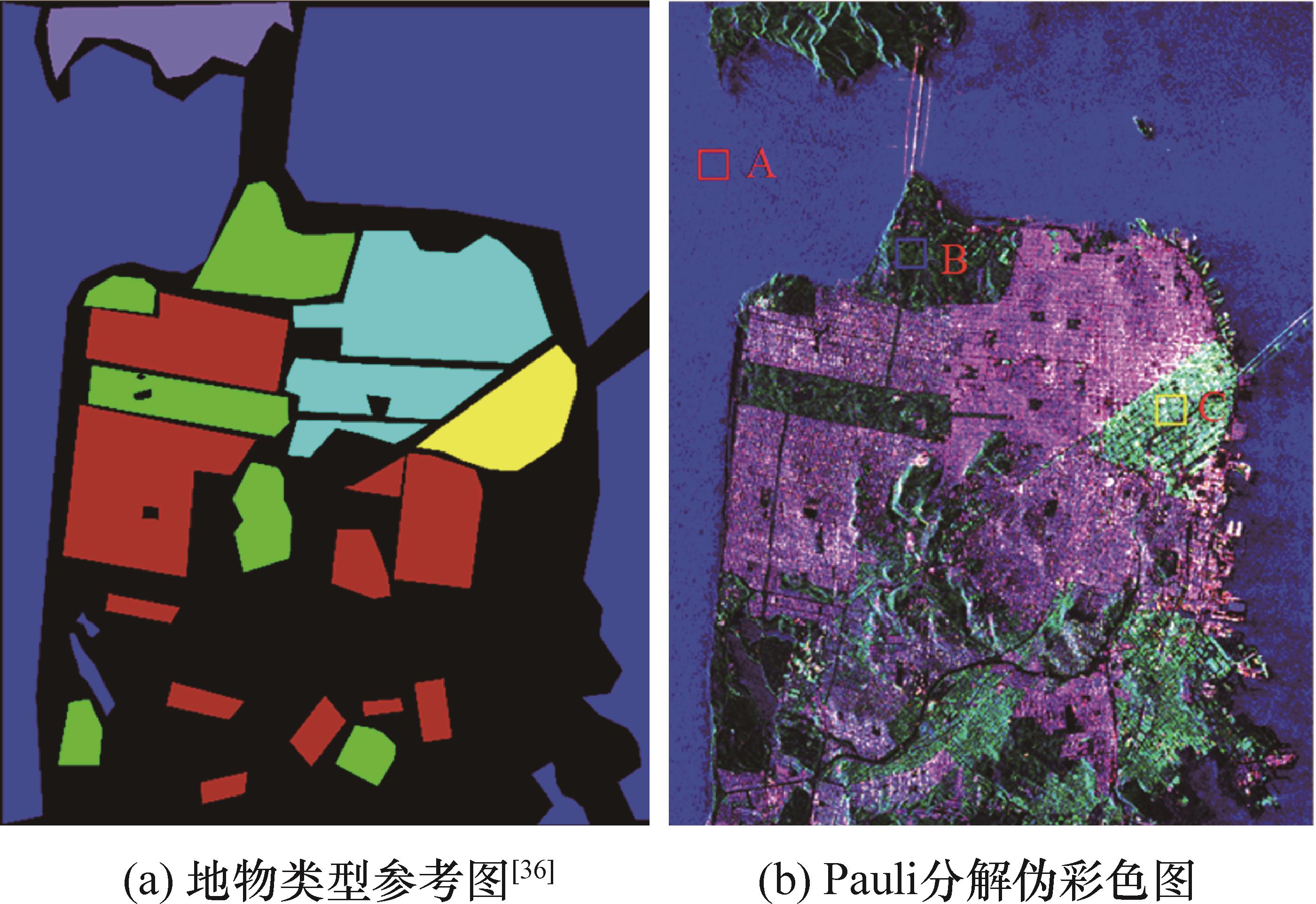
Fig.3 Terrain feature and Pauli RGB pseudo-color image of the airborne full-polarimetric data over San Francisco acquired by GF-3

Fig.4 Results obtained by different decomposition methods over Oberpfaffenhofen
| 方法 | |||
|---|---|---|---|
| CMD-ED | 45.97 | 26.79 | 27.24 |
| CMD-MF | 45.43 | 27.33 | 27.24 |
| ICMD | 45.57 | 27.19 | 27.24 |
| RCMD | 44.40 | 28.37 | 27.23 |
Table 1 Mean normalized scattering power over Oberpfaffenhofen
| 方法 | |||
|---|---|---|---|
| CMD-ED | 45.97 | 26.79 | 27.24 |
| CMD-MF | 45.43 | 27.33 | 27.24 |
| ICMD | 45.57 | 27.19 | 27.24 |
| RCMD | 44.40 | 28.37 | 27.23 |
| 方法 | |||
|---|---|---|---|
| CMD-ED | 98.88 | 96.42 | 100 |
| CMD-MF | 93.38 | 77.67 | 100 |
| ICMD | 93.96 | 77.46 | 100 |
| RCMD | 100 | 100 | 100 |
Table 2 Percentage of positive power pixels over Oberpfaffenhofen
| 方法 | |||
|---|---|---|---|
| CMD-ED | 98.88 | 96.42 | 100 |
| CMD-MF | 93.38 | 77.67 | 100 |
| ICMD | 93.96 | 77.46 | 100 |
| RCMD | 100 | 100 | 100 |
| 区域 | 方法 | |||
|---|---|---|---|---|
| A | CMD-ED | 16.99 | 29.97 | 53.04 |
| CMD-MF | 18.23 | 28.73 | 53.04 | |
| ICMD | 18.34 | 28.62 | 53.04 | |
| RCMD | 17.80 | 29.19 | 53.01 | |
| B | CMD-ED | 27.26 | 56.38 | 16.36 |
| CMD-MF | 28.65 | 54.99 | 16.36 | |
| ICMD | 28.61 | 55.03 | 16.36 | |
| RCMD | 27.10 | 56.55 | 16.35 | |
| C | CMD-ED | 76.25 | 14.46 | 9.29 |
| CMD-MF | 76.62 | 14.09 | 9.29 | |
| ICMD | 76.67 | 14.04 | 9.29 | |
| RCMD | 76.72 | 13.99 | 9.29 |
Table 3 Percentage of each component power extracted by different decomposition methods in different subregions over Oberpfaffenhofen
| 区域 | 方法 | |||
|---|---|---|---|---|
| A | CMD-ED | 16.99 | 29.97 | 53.04 |
| CMD-MF | 18.23 | 28.73 | 53.04 | |
| ICMD | 18.34 | 28.62 | 53.04 | |
| RCMD | 17.80 | 29.19 | 53.01 | |
| B | CMD-ED | 27.26 | 56.38 | 16.36 |
| CMD-MF | 28.65 | 54.99 | 16.36 | |
| ICMD | 28.61 | 55.03 | 16.36 | |
| RCMD | 27.10 | 56.55 | 16.35 | |
| C | CMD-ED | 76.25 | 14.46 | 9.29 |
| CMD-MF | 76.62 | 14.09 | 9.29 | |
| ICMD | 76.67 | 14.04 | 9.29 | |
| RCMD | 76.72 | 13.99 | 9.29 |

Fig.5 Results obtained by different decomposition methods over San Francisco
| 方法 | |||
|---|---|---|---|
| CMD-ED | 70.58 | 14.49 | 14.93 |
| CMD-MF | 71.37 | 13.70 | 14.93 |
| ICMD | 71.56 | 13.51 | 14.93 |
| RCMD | 69.99 | 16.23 | 14.78 |
Table 4 Mean normalized scattering powers over San Francisco
| 方法 | |||
|---|---|---|---|
| CMD-ED | 70.58 | 14.49 | 14.93 |
| CMD-MF | 71.37 | 13.70 | 14.93 |
| ICMD | 71.56 | 13.51 | 14.93 |
| RCMD | 69.99 | 16.23 | 14.78 |
| 方法 | |||
|---|---|---|---|
| CMD-ED | 98.72 | 94.62 | 100 |
| CMD-MF | 97.70 | 35.58 | 100 |
| ICMD | 98.74 | 33.97 | 100 |
| RCMD | 100 | 100 | 100 |
Table 5 Percentage of positive power pixels over San Francisco
| 方法 | |||
|---|---|---|---|
| CMD-ED | 98.72 | 94.62 | 100 |
| CMD-MF | 97.70 | 35.58 | 100 |
| ICMD | 98.74 | 33.97 | 100 |
| RCMD | 100 | 100 | 100 |
| 区域 | 方法 | |||
|---|---|---|---|---|
| A | CMD-ED | 98.40 | 0.77 | 0.83 |
| CMD-MF | 98.78 | 0.39 | 0.83 | |
| ICMD | 98.82 | 0.35 | 0.83 | |
| RCMD | 99.16 | 0.01 | 0.83 | |
| B | CMD-ED | 37.13 | 28.41 | 34.46 |
| CMD-MF | 40.80 | 24.74 | 34.46 | |
| ICMD | 40.25 | 25.29 | 34.46 | |
| RCMD | 37.28 | 28.56 | 34.06 | |
| C | CMD-ED | 40.36 | 15.32 | 44.32 |
| CMD-MF | 39.15 | 16.53 | 44.32 | |
| ICMD | 41.95 | 13.73 | 44.32 | |
| RCMD | 38.19 | 17.96 | 43.85 |
Table 6 Percentage of each component power extracted by different decomposition methods in different subregions over San Francisco
| 区域 | 方法 | |||
|---|---|---|---|---|
| A | CMD-ED | 98.40 | 0.77 | 0.83 |
| CMD-MF | 98.78 | 0.39 | 0.83 | |
| ICMD | 98.82 | 0.35 | 0.83 | |
| RCMD | 99.16 | 0.01 | 0.83 | |
| B | CMD-ED | 37.13 | 28.41 | 34.46 |
| CMD-MF | 40.80 | 24.74 | 34.46 | |
| ICMD | 40.25 | 25.29 | 34.46 | |
| RCMD | 37.28 | 28.56 | 34.06 | |
| C | CMD-ED | 40.36 | 15.32 | 44.32 |
| CMD-MF | 39.15 | 16.53 | 44.32 | |
| ICMD | 41.95 | 13.73 | 44.32 | |
| RCMD | 38.19 | 17.96 | 43.85 |
| [1] | Cloude S R, Pottier E. A review of target decomposition theorems in radar polarimetry[J]. IEEE Transactions on Geoscience and Remote Sensing, 1996, 34(2): 498-518. DOI: 10.1109/36.485127 . |
| [2] | Lee J S, Pottier E. Polarimetric radar imaging: from basics to applications[M]. Boca Raton, Florida, USA: CRC Press, 2017. |
| [3] | Cloude S. Polarisation applications in remote sensing[M]. Oxford: Oxford University Press, 2010. |
| [4] | 王春乐, 禹卫东. Huynen类型目标分解方法的比较与分析[J]. 中国科学院研究生院学报, 2011, 28 (3): 402-409. DOI: 10.7523/j.issn.2095-6134.2011.3.019 . |
| [5] | Cloude S R, Pottier E. An entropy based classification scheme for land applications of polarimetric SAR[J]. IEEE Transactions on Geoscience and Remote Sensing, 1997, 35(1): 68-78. DOI: 10.1109/36.551935 . |
| [6] | Yajima Y, Yamaguchi Y, Sato R, et al. POLSAR image analysis of wetlands using a modified four-component scattering power decomposition[J]. IEEE Transactions on Geoscience and Remote Sensing, 2008, 46(6): 1667-1673. DOI: 10.1109/TGRS.2008.916326 . |
| [7] | Li D, Lu H, Zhang Y H. Solid angle geometry-based modeling of volume scattering with application in the adaptive decomposition of GF-3 data of sea ice in Antarctica[J]. Remote Sensing, 2023, 15(12): 3208. DOI: 10.3390/rs15123208 . |
| [8] | Touzi R, Boerner W M, Lee J S, et al. A review of polarimetry in the context of synthetic aperture radar: concepts and information extraction[J]. Canadian Journal of Remote Sensing, 2004, 30(3): 380-407. DOI: 10.5589/m04-013 . |
| [9] | Bargiel D. A new method for crop classification combining time series of radar images and crop phenology information[J]. Remote Sensing of Environment, 2017, 198: 369-383. DOI: 10.1016/j.rse.2017.06.022 . |
| [10] | Xu F, Jin Y Q. Deorientation theory of polarimetric scattering targets and application to terrain surface classification[J]. IEEE Transactions on Geoscience and Remote Sensing, 2005, 43(10): 2351-2364. DOI: 10.1109/TGRS.2005.855064 . |
| [11] | Singh G, Yamaguchi Y, Boerner W M, et al. Monitoring of the March 11, 2011, off-tohoku 9.0 earthquake with super-tsunami disaster by implementing fully polarimetric high-resolution POLSAR techniques[J]. Proceedings of the IEEE, 2013, 101(3): 831-846. DOI: 10.1109/JPROC.2012.2230311 . |
| [12] | Yamaguchi Y. Disaster monitoring by fully polarimetric SAR data acquired with ALOS-PALSAR[J]. Proceedings of the IEEE, 2012, 100(10): 2851-2860. DOI: 10.1109/JPROC.2012.2195469 . |
| [13] | Dong H W, Zhang L M, Zou B. Exploring vision transformers for polarimetric SAR image classification[J]. IEEE Transactions on Geoscience and Remote Sensing, 2022, 60: 1-15. DOI: 10.1109/TGRS.2021.3137383 . |
| [14] | 刘杉, 张风丽, 韦诗莹, 等. 基于极化分解组合的SAR图像视觉优化和建筑物损毁评估[J]. 中国科学院大学学报, 2020, 37(6): 750-759. DOI: 10.7523/j.issn.2095-6134.2020.06.005 . |
| [15] | 王懿泽, 孙吉利, 闫成杰, 等. 基于超像素与LightGBM的极化SAR图像地物分类[J]. 中国科学院大学学报, 2023, 40(5): 658-669. DOI: 10.7523/j.ucas.2022.023 . |
| [16] | Freeman A, Durden S L. A three-component scattering model for polarimetric SAR data[J]. IEEE Transactions on Geoscience and Remote Sensing, 1998, 36(3): 963-973. DOI: 10.1109/36.673687 . |
| [17] | Yamaguchi Y, Moriyama T, Ishido M, et al. Four-component scattering model for polarimetric SAR image decomposition[J]. IEEE Transactions on Geoscience and Remote Sensing, 2005, 43(8): 1699-1706. DOI: 10.1109/TGRS.2005.852084 . |
| [18] | Cui Y, Yamaguchi Y, Yang J, et al. On complete model-based decomposition of polarimetric SAR coherency matrix data[J]. IEEE Transactions on Geoscience and Remote Sensing, 2014, 52(4): 1991-2001. DOI: 10.1109/TGRS.2013.2257603 . |
| [19] | Chen S W, Sato M. General polarimetric model-based decomposition for coherency matrix[C]//2012 IEEE International Geoscience and Remote Sensing Symposium. Munich, Germany. IEEE, 2012: 99-102. DOI: 10.1109/IGARSS.2012.6351627 . |
| [20] | An W T, Cui Y, Yang J. Three-component model-based decomposition for polarimetric SAR data[J]. IEEE Transactions on Geoscience and Remote Sensing, 2010, 48(6): 2732-2739. DOI: 10.1109/TGRS.2010.2041242 . |
| [21] | Sato A, Yamaguchi Y, Singh G, et al. Four-component scattering power decomposition with extended volume scattering model[J]. IEEE Geoscience and Remote Sensing Letters, 2012, 9(2): 166-170. DOI: 10.1109/LGRS.2011.2162935 . |
| [22] | van Zyl J J, Arii M, Kim Y. Model-based decomposition of polarimetric SAR covariance matrices constrained for nonnegative eigenvalues[J]. IEEE Transactions on Geoscience and Remote Sensing, 2011, 49(9): 3452-3459. DOI: 10.1109/TGRS.2011.2128325 . |
| [23] | 刘高峰, 李明, 王亚军, 等. 一种新的基于非反射对称非负特征值分解的Freeman分解[J]. 电子与信息学报, 2013, 35(2): 368-375. DOI: 10.3724/SP.J.1146.2012.00897 . |
| [24] | Wang C L, Yu W D, Wang R, et al. Comparison of nonnegative eigenvalue decompositions with and without reflection symmetry assumptions[J]. IEEE Transactions on Geoscience and Remote Sensing, 2014, 52(4): 2278-2287. DOI: 10.1109/TGRS.2013.2259177 . |
| [25] | An W T, Xie C H. An improvement on the complete model-based decomposition of polarimetric SAR data[J]. IEEE Geoscience and Remote Sensing Letters, 2014, 11(11): 1926-1930. DOI: 10.1109/LGRS.2014.2313955 . |
| [26] | Li D, Zhang Y H. Unified Huynen phenomenological decomposition of radar targets and its classification applications[J]. IEEE Transactions on Geoscience and Remote Sensing, 2016, 54(2): 723-743. DOI: 10.1109/TGRS.2015.2464113 . |
| [27] | Touzi R. Target scattering decomposition in terms of roll-invariant target parameters[J]. IEEE Transactions on Geoscience and Remote Sensing, 2007, 45(1): 73-84. DOI: 10.1109/TGRS.2006.886176 . |
| [28] | Singh G, Yamaguchi Y, Park S-E. General four-component scattering power decomposition with unitary transformation of coherency matrix[J]. IEEE Transactions on Geoscience and Remote Sensing, 2013, 51(5): 3014-3022. DOI: 10.1109/TGRS.2012.2212446 . |
| [29] | Yamaguchi Y, Sato A, Boerner W M, et al. Four-component scattering power decomposition with rotation of coherency matrix[J]. IEEE Transactions on Geoscience and Remote Sensing, 2011, 49(6): 2251-2258. DOI: 10.1109/TGRS.2010.2099124 . |
| [30] | Li D, Zhang Y H, Liang L T. A mathematical extension to the general four-component scattering power decomposition with unitary transformation of coherency matrix[J]. IEEE Transactions on Geoscience and Remote Sensing, 2020, 58(11): 7772-7789. DOI: 10.1109/TGRS.2020.2983758 . |
| [31] | Chen S W, Wang X S, Sato M. Uniform polarimetric matrix rotation theory and its applications[J]. IEEE Transactions on Geoscience and Remote Sensing, 2014, 52(8): 4756-4770. DOI: 10.1109/TGRS.2013.2284359 . |
| [32] | Xiang D L, Tang T, Ban Y F, et al. Unsupervised polarimetric SAR urban area classification based on model-based decomposition with cross scattering[J]. ISPRS Journal of Photogrammetry and Remote Sensing, 2016, 116: 86-100. DOI: 10.1016/j.isprsjprs.2016.03.009 . |
| [33] | 方保镕, 周继东, 李医民. 矩阵论[M]. 2版. 北京: 清华大学出版社, 2013. |
| [34] | Dey S, Bhattacharya A, Ratha D, et al. Target characterization and scattering power decomposition for full and compact polarimetric SAR data[J]. IEEE Transactions on Geoscience and Remote Sensing, 2021, 59(5): 3981–3998. DOI:10.1109/TGRS.2020.3010840 . |
| [35] | 王贤圆. 极化合成孔径雷达图像特征表示与目标分类方法研究[D]. 成都: 电子科技大学, 2021. |
| [36] | Liu X, Jiao L C, Liu F. PolSF: PolSAR image dataset on San Francisco[EB/OL].arXiv 2019: 1912.07259. (2019-12-16)[2023-12-20]. . |
| [1] | ZHANG Jing-Yi, LEI Bin, LIU Tuan-Jie. A new spatial speckle reduction method for polarimetric SAR data [J]. , 2013, 30(1): 60-67. |
| Viewed | ||||||
|
Full text |
|
|||||
|
Abstract |
|
|||||
Copyright © Journal of University of Chinese Academy of Sciences
Support by Beijing Magtech Co.ltd support@magtech.com.cn

