Journal of University of Chinese Academy of Sciences ›› 2026, Vol. 43 ›› Issue (1): 80-92.DOI: 10.7523/j.ucas.2024.054
• Electronics and Computer Science • Previous Articles Next Articles
Jiayi ZHAO1,2,3, Yong MA1,2( ), Fu CHEN2, Wutao YAO2, Erping SHANG2, Shuyan ZHANG2, An LONG4
Received:2023-01-30
Revised:2024-05-21
Online:2026-01-15
Contact:
Yong MA
CLC Number:
Jiayi ZHAO, Yong MA, Fu CHEN, Wutao YAO, Erping SHANG, Shuyan ZHANG, An LONG. Super-resolution reconstruction of high-resolution remote sensing images for real scenes[J]. Journal of University of Chinese Academy of Sciences, 2026, 43(1): 80-92.
Add to citation manager EndNote|Ris|BibTeX
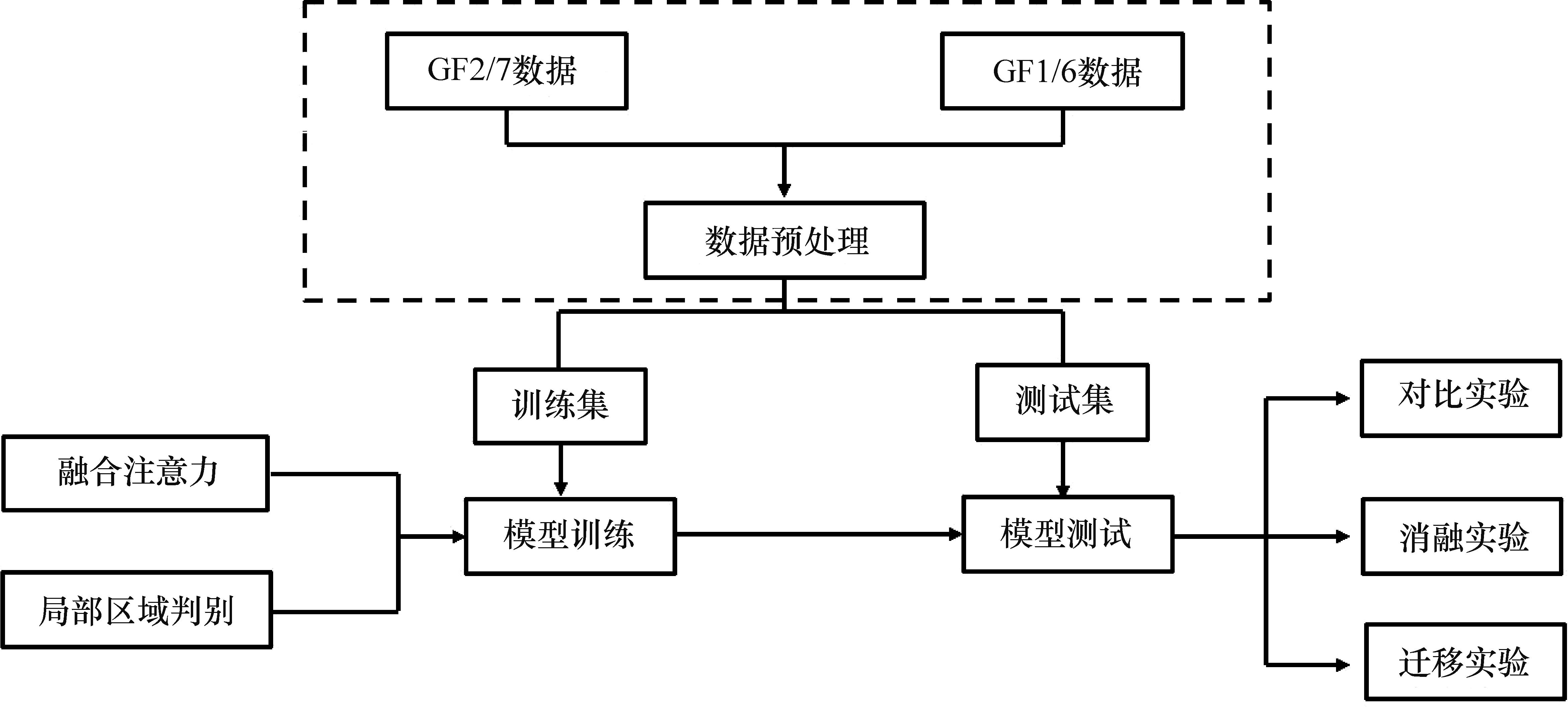
Fig.1 Overall flow chart
| 卫星 | 全色波段分辨率 | 多光谱波段分辨率 |
|---|---|---|
| GF1 | 2.0 | 8.0 |
| GF1B/C/D | 2.0 | 8.0 |
| GF2 | 0.8(星下点) | 3.2(星下点) |
| GF6 | 1.0 | 2.0 |
| GF7 | 0.8 | 3.2 |
Table 1 Satellite and spatial resolution ofthe dataset
| 卫星 | 全色波段分辨率 | 多光谱波段分辨率 |
|---|---|---|
| GF1 | 2.0 | 8.0 |
| GF1B/C/D | 2.0 | 8.0 |
| GF2 | 0.8(星下点) | 3.2(星下点) |
| GF6 | 1.0 | 2.0 |
| GF7 | 0.8 | 3.2 |

Fig.2 Network framework diagram
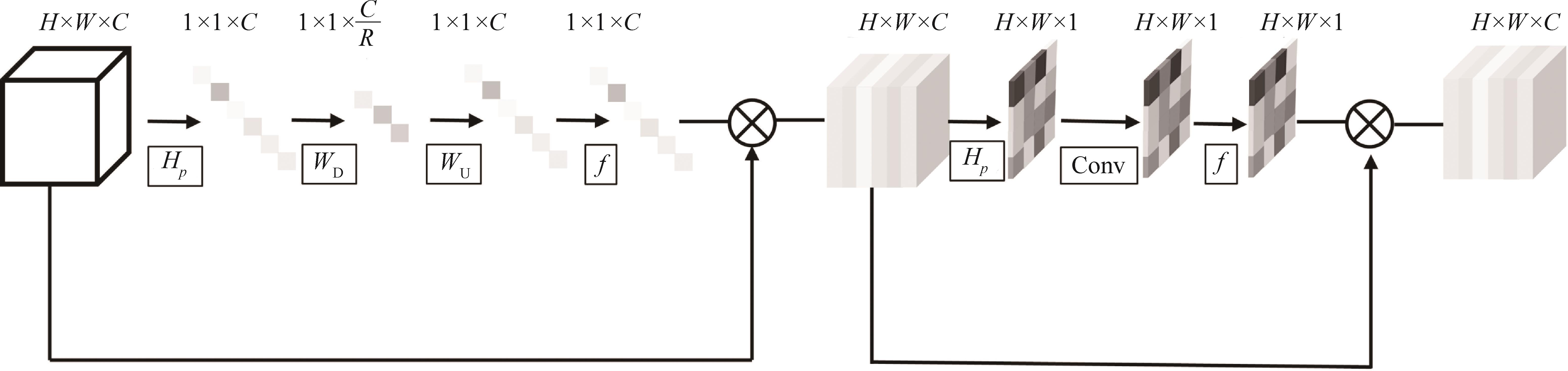
Fig.3 Internal structure of CSA

Fig.4 Comparison of the HR image with the real LR image
| 参数 | 设置 |
|---|---|
| 批次规格 | 8 |
| 训练迭代次数 | 450 000 |
| 优化方法 | Adam, |
| 学习率 | 1e-4 |
Table 2 Detailed configuration of the model
| 参数 | 设置 |
|---|---|
| 批次规格 | 8 |
| 训练迭代次数 | 450 000 |
| 优化方法 | Adam, |
| 学习率 | 1e-4 |
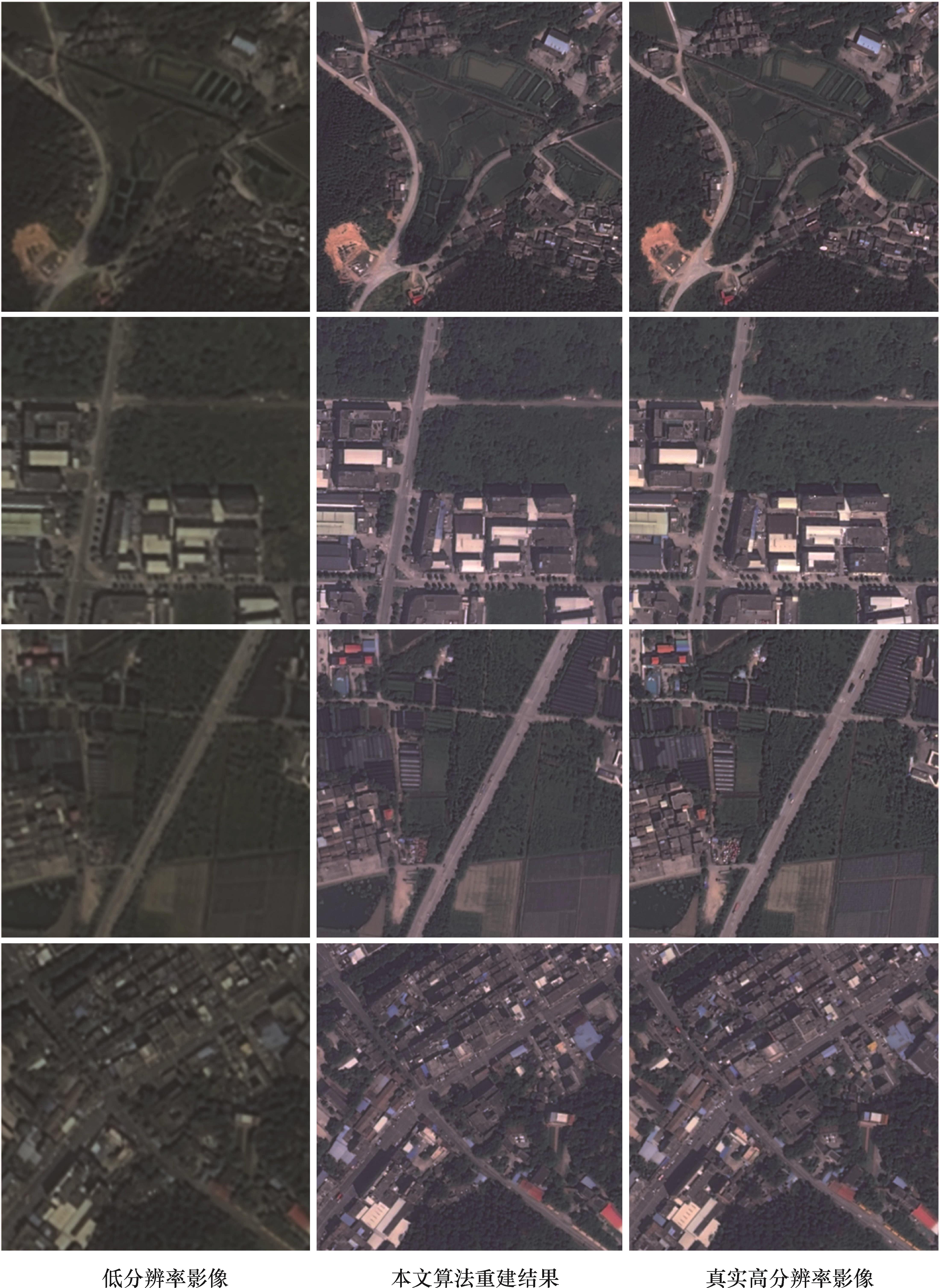
Fig. 5 Comparison of the algorithm in this paper with the real HR image
| 模型 | PSNR | SSIM | FID | LPIPS |
|---|---|---|---|---|
| Bicubic | 16.894 1 | 0.574 8 | 0.545 4 | 71.680 0 |
| SRResNet | 26.326 5 | 0.662 6 | 0.423 0 | 66.757 3 |
| EDSR | 27.417 6 | 0.717 2 | 0.352 0 | 51.435 7 |
| RCAN | 26.685 1 | 0.682 8 | 0.399 5 | 54.029 1 |
| SRGAN | 24.772 9 | 0.592 2 | 0.289 2 | 20.051 4 |
| ESRGAN | 24.822 0 | 0.590 6 | 0.282 9 | 19.126 6 |
| 本文 | 25.741 8 | 0.647 4 | 0.246 5 | 18.247 6 |
Table 3 Comparison of metrics of different models on the data set
| 模型 | PSNR | SSIM | FID | LPIPS |
|---|---|---|---|---|
| Bicubic | 16.894 1 | 0.574 8 | 0.545 4 | 71.680 0 |
| SRResNet | 26.326 5 | 0.662 6 | 0.423 0 | 66.757 3 |
| EDSR | 27.417 6 | 0.717 2 | 0.352 0 | 51.435 7 |
| RCAN | 26.685 1 | 0.682 8 | 0.399 5 | 54.029 1 |
| SRGAN | 24.772 9 | 0.592 2 | 0.289 2 | 20.051 4 |
| ESRGAN | 24.822 0 | 0.590 6 | 0.282 9 | 19.126 6 |
| 本文 | 25.741 8 | 0.647 4 | 0.246 5 | 18.247 6 |

Fig.6 Comparison of recovery results of different models in different scenarios
| 添加的模块 | PSNR | SSIM | FID | LPIPS |
|---|---|---|---|---|
| 无 | 24.892 7 | 0.614 6 | 0.274 1 | 18.947 2 |
| 伪影抑制 | 25.472 8 | 0.632 1 | 0.254 2 | 18.627 5 |
| 融合注意力 | 25.501 7 | 0.638 6 | 0.253 3 | 18.872 1 |
| 伪影抑制+融合注意力 | 25.741 8 | 0.647 4 | 0.246 5 | 18.247 6 |
Table 4 Comparison of indicators in ablation experiments
| 添加的模块 | PSNR | SSIM | FID | LPIPS |
|---|---|---|---|---|
| 无 | 24.892 7 | 0.614 6 | 0.274 1 | 18.947 2 |
| 伪影抑制 | 25.472 8 | 0.632 1 | 0.254 2 | 18.627 5 |
| 融合注意力 | 25.501 7 | 0.638 6 | 0.253 3 | 18.872 1 |
| 伪影抑制+融合注意力 | 25.741 8 | 0.647 4 | 0.246 5 | 18.247 6 |

Fig.7 Comparison of recovery results in ablation experiments
| 区域 | SRResNet | EDSR | RCAN | SRGAN | ESRGAN | 本文 |
|---|---|---|---|---|---|---|
| 陕西汉中 | 8.215 6 | 8.157 9 | 8.519 6 | 6.254 9 | 6.545 5 | 6.182 7 |
| 北京 | 6.683 7 | 8.013 9 | 8.110 7 | 4.769 0 | 5.292 6 | 4.743 9 |
Table 5 Quantitative evaluation of 2x super-resolution reconstruction results of different models in different regions
| 区域 | SRResNet | EDSR | RCAN | SRGAN | ESRGAN | 本文 |
|---|---|---|---|---|---|---|
| 陕西汉中 | 8.215 6 | 8.157 9 | 8.519 6 | 6.254 9 | 6.545 5 | 6.182 7 |
| 北京 | 6.683 7 | 8.013 9 | 8.110 7 | 4.769 0 | 5.292 6 | 4.743 9 |

Fig.8 Results of the migration experiment at different times and regions
| [1] | Olivier R, Cao H Q. Nearest neighbor value interpolation[J]. International Journal of Advanced Computer Science and Applications, 2012, 3(4):25-30. DOI: 10.14569/ijacsa.2012.030405 . |
| [2] | Zhang X G. A new kind of super-resolution reconstruction algorithm based on the ICM and the bilinear interpolation[C]//2008 International Seminar on Future BioMedical Information Engineering. December 18-18, 2008, Wuhan, China. IEEE, 2009: 183-186. DOI: 10.1109/FBIE.2008.44 . |
| [3] | Zhang X G. A new kind of super-resolution reconstruction algorithm based on the ICM and the bicubic interpolation[C]//2008 International Symposium on Intelligent Information Technology Application Workshops. December 21-22, 2008, Shanghai, China. IEEE, 2008: 817-820. DOI: 10.1109/IITA.Workshops.2008.12 . |
| [4] | Rasti P, Demirel H, Anbarjafari G. Image resolution enhancement by using interpolation followed by iterative back projection[C]//2013 21st Signal Processing and Communications Applications Conference (SIU). April 24-26, 2013, Haspolat, Turkey. IEEE, 2013: 1-4. DOI: 10.1109/SIU.2013.6531593 . |
| [5] | Wheeler F W, Hoctor R T, Barrett E B. Super-resolution image synthesis using projections onto convex sets in the frequency domain[C]//Proc SPIE 5674, Computational Imaging III, 2005, 5674: 479-490. DOI: 10.1117/12.605436 . |
| [6] | 李利, 尹增山, 石神. 联合L1和L0先验模型的超分辨率重建算法[J]. 中国科学院大学学报, 2022, 39(3): 369-376. DOI: 10.7523/j.ucas.2020.0013 . |
| [7] | 浦剑, 张军平, 黄华. 超分辨率算法研究综述 [J]. 山东大学学报(工学版), 2009, 39(1): 27-32. |
| [8] | Dong C, Loy C C, He K M, et al. Image super-resolution using deep convolutional networks[J]. IEEE Transactions on Pattern Analysis and Machine Intelligence, 2015, 38(2): 295-307. DOI: 10.1109/TPAMI.2015.2439281 . |
| [9] | Dong C, Loy C C, Tang X O. Accelerating the super-resolution convolutional neural network[C]//European Conference on Computer Vision. Cham: Springer, 2016: 391-407.10.1007/978-3-319-46475-6_25. |
| [10] | Kim J, Lee J K, Lee K M. Accurate image super-resolution using very deep convolutional networks[C]//2016 IEEE Conference on Computer Vision and Pattern Recognition (CVPR). June 27-30, 2016, Las Vegas, NV, USA. IEEE, 2016: 1646-1654. DOI: 10.1109/CVPR.2016.182 . |
| [11] | Lim B, Son S, Kim H, et al. Enhanced deep residual networks for single image super-resolution[C]//2017 IEEE Conference on Computer Vision and Pattern Recognition Workshops (CVPRW). July 21-26, 2017, Honolulu, HI, USA. IEEE, 2017: 1132-1140. DOI: 10.1109/CVPRW.2017.151 . |
| [12] | Zhang Y L, Li K P, Li K, et al. Image super-resolution using very deep residual channel attention networks[C]//European Conference on Computer Vision. Cham: Springer, 2018: 294-310.10.1007/978-3-030-01234-2_18. |
| [13] | Ledig C, Theis L, Huszár F, et al. Photo-realistic single image super-resolution using a generative adversarial network[C]//2017 IEEE Conference on Computer Vision and Pattern Recognition (CVPR). Honolulu, HI, USA. IEEE, 2017: 105-114. DOI: 10.1109/CVPR.2017.19 . |
| [14] | Wang X T, Yu K, Wu S X, et al. ESRGAN: enhanced super-resolution generative adversarial networks[C]//European Conference on Computer Vision. Cham: Springer, 2019: 63-79.10.1007/978-3-030-11021-5_5. |
| [15] | Wang X T, Yu K, Dong C, et al. Recovering realistic texture in image super-resolution by deep spatial feature transform[C]//2018 IEEE/CVF Conference on Computer Vision and Pattern Recognition. June 18-23, 2018, Salt Lake City, UT, USA. IEEE, 2018: 606-615. DOI: 10.1109/CVPR.2018.00070 . |
| [16] | Szegedy C, Ioffe S, Vanhoucke V, et al. Inception-v4, inception-ResNet and the impact of residual connections on learning[C]//Proceedings of the Thirty-First AAAI Conference on Artificial Intelligence. February 4 - 9, 2017, San Francisco, California, USA. New York: ACM, 2017: 4278-4284. DOI: 10.5555/3298023.3298188 . |
| [17] | Huang H M, Lin L F, Tong R F, et al. UNet 3: a full-scale connected UNet for medical image segmentation[C]//ICASSP 2020 - 2020 IEEE International Conference on Acoustics, Speech and Signal Processing (ICASSP). May 4-8, 2020, Barcelona, Spain. IEEE, 2020: 1055-1059. DOI: 10.1109/ICASSP40776.2020.9053405 . |
| [18] | Miyato T, Kataoka T, Koyama M, et al. Spectral normalization for generative adversarial networks[EB/OL]. arXiv 2018: 1802.05957. (2018-02-16)[2023-01-30]. . |
| [19] | Johnson J, Alahi A, Li F F. Perceptual losses for real-time style transfer and super-resolution[C]//European Conference on Computer Vision. Cham: Springer, 2016: 694-711.10.1007/978-3-319-46475-6_43. |
| [20] | Bruna J, Sprechmann P, LeCun Y. Super-resolution with deep convolutional sufficient statistics[EB/OL]. arXiv 2015: 1511.05666. (2015-11-18)[2023-01-30]. . |
| [21] | Dosovitskiy A, Brox T. Generating images with perceptual similarity metrics based on deep networks[C]//Proceedings of the 30th International Conference on Neural Information Processing Systems. New York: ACM, 2016: 658-666. DOI: 10.5555/3157096.3157170 . |
| [22] | Zhao H, Gallo O, Frosio I, et al. Loss functions for image restoration with neural networks[J]. IEEE Transactions on Computational Imaging, 2017, 3(1): 47-57. DOI: 10.1109/TCI.2016.2644865 . |
| [23] | Wang X T, Xie L B, Dong C, et al. Real-ESRGAN: training real-world blind super-resolution with pure synthetic data[C]//2021 IEEE/CVF International Conference on Computer Vision Workshops (ICCVW). October 11-17, 2021, Montreal, BC, Canada. IEEE, 2021: 1905-1914. DOI: 10.1109/ICCVW54120.2021.00217 . |
| [24] | Korhonen J, You J Y. Peak signal-to-noise ratio revisited: Is simple beautiful? [C]//2012 Fourth International Workshop on Quality of Multimedia Experience. July 5-7, 2012, Melbourne, VIC, Australia. IEEE, 2012: 37-38. DOI: 10.1109/QoMEX.2012.6263880 . |
| [25] | Wang Z, Bovik A C, Sheikh H R, et al. Image quality assessment: from error visibility to structural similarity[J]. IEEE Transactions on Image Processing: a Publication of the IEEE Signal Processing Society, 2004, 13(4): 600-612. DOI: 10.1109/tip.2003.819861 . |
| [26] | Heusel M, Ramsauer H, Unterthiner T, et al. GANs trained by a two time-scale update rule converge to a local Nash equilibrium[C]//Proceedings of the 31st International Conference on Neural Information Processing Systems. December 4 - 9, 2017, Long Beach, California, USA. New York: ACM, 2017: 6629-6640. DOI: 10.5555/3295222.3295408 . |
| [27] | Zhang R, Isola P, Efros A A, et al. The unreasonable effectiveness of deep features as a perceptual metric[C]//2018 IEEE/CVF Conference on Computer Vision and Pattern Recognition. June 18-23, 2018, Salt Lake City, UT, USA. IEEE, 2018: 586-595. DOI: 10.1109/CVPR.2018.00068 . |
| [28] | Mittal A, Soundararajan R, Bovik A C. Making a “completely blind” image quality analyzer[J]. IEEE Signal Processing Letters, 2013, 20(3): 209-212. DOI: 10.1109/LSP.2012.2227726 . |
| [1] | Ruiqi SUN, Wenjuan ZHANG, Zhen LI, Xuesong MA, Junlin MEI. Effect of patch size on super-resolution of large scene remote sensing images [J]. Journal of University of Chinese Academy of Sciences, 2026, 43(1): 93-103. |
| [2] | ZHANG Bingyu, PAN Zhigang, YAO Kai, DONG Xubin. SAR decompressed image reconstruction algorithm based on generative adversarial network [J]. Journal of University of Chinese Academy of Sciences, 2025, 42(5): 666-676. |
| [3] | LEI Haojing, XU Ri, QU Songbo, SHAMA Ribu, LI Fengzi, ZHANG Lin, LIANG Eryuan. Effects of agricultural activities on soil inorganic nitrogen along an altitudinal gradient in Motuo, Southeastern Xizang, China [J]. Journal of University of Chinese Academy of Sciences, 2025, 42(3): 328-338. |
| [4] | SONG Guoxue, QIN Zhangwei, ZHANG Daiyue, ZHENG Fangshun, XIONG Yuxin. Potoushan Kaolin Deposit in the middle of the Greater Khingan Range: identification of lithocaps and its significance [J]. Journal of University of Chinese Academy of Sciences, 2025, 42(3): 289-303. |
| [5] | ZHONG Jinyan, CHEN Jun, LI Yu, WU Yewei, GE Xiaoqing. Cross-modal retrieval method based on MFF-SFE for remote sensing image-text [J]. Journal of University of Chinese Academy of Sciences, 2025, 42(2): 236-247. |
| [6] | HOU Xingao, JU Yiwen, FENG Hongye, XIAO Lei, QIAO Peng, TAO Liru, WANG Peng, WANG Wei, GAO Jian. Organic mineralization in lead-zinc deposits: a case study of the Jinding lead-zinc deposit, Lanping Basin [J]. Journal of University of Chinese Academy of Sciences, 2025, 42(1): 86-106. |
| [7] | YU Yongsheng, LUO Tiejian. Seamless image completion via GAN inversion [J]. Journal of University of Chinese Academy of Sciences, 2024, 41(5): 705-714. |
| [8] | CHEN Jingwei, LI Yu, CHEN Jun, ZHANG Hongqun. Building extraction method based on MFF-Deeplabv3+ network for high-resolution remote sensing images [J]. Journal of University of Chinese Academy of Sciences, 2024, 41(5): 654-664. |
| [9] | ZHENG Xiaoman, WENG Xian, OU Linglong, REN Yin. Allometric equation and biomass estimation of Eucalyptus in Fujian [J]. Journal of University of Chinese Academy of Sciences, 2024, 41(3): 321-333. |
| [10] | WANG Zhengsheng, LI Yalin, ZHANG Hongqun. Satellite data receiving system fault location based on GAN sequence [J]. Journal of University of Chinese Academy of Sciences, 2023, 40(1): 109-118. |
| [11] | ZHOU Bi, HU Jun, QI Yixuan, ZHANG Lijia, HUO Peng, ZHANG Yuanxun, ZHANG Yang, WANG Shulan. Atmospheric VOCs and their contribution to O3 and SOA formation in summer of Huairou District, Beijing City [J]. Journal of University of Chinese Academy of Sciences, 2023, 40(1): 39-49. |
| [12] | ZHAO Xinchi, JIANG Ce, HE Wei. Removing highlights from single image via an attention-auxiliary generative adversarial network [J]. Journal of University of Chinese Academy of Sciences, 2022, 39(4): 524-531. |
| [13] | HU Bingbing, TANG Hua, WU Youlong. Classification models based on generative adversarial networks with mutual information regularization [J]. Journal of University of Chinese Academy of Sciences, 2022, 39(4): 551-560. |
| [14] | LI Li, YIN Zengshan, SHI Shen. Super-resolution reconstruction algorithm by combining L1 and L0 prior models [J]. Journal of University of Chinese Academy of Sciences, 2022, 39(3): 369-376. |
| [15] | WEI Rui, XIE Zhuochen, LIU Jie, LIU Huijie. Spatial resolution improvement of spectrum sensing data of LEO satellite based on image super-resolution [J]. Journal of University of Chinese Academy of Sciences, 2022, 39(3): 386-392. |
| Viewed | ||||||
|
Full text |
|
|||||
|
Abstract |
|
|||||
Copyright © Journal of University of Chinese Academy of Sciences
Support by Beijing Magtech Co.ltd support@magtech.com.cn

